
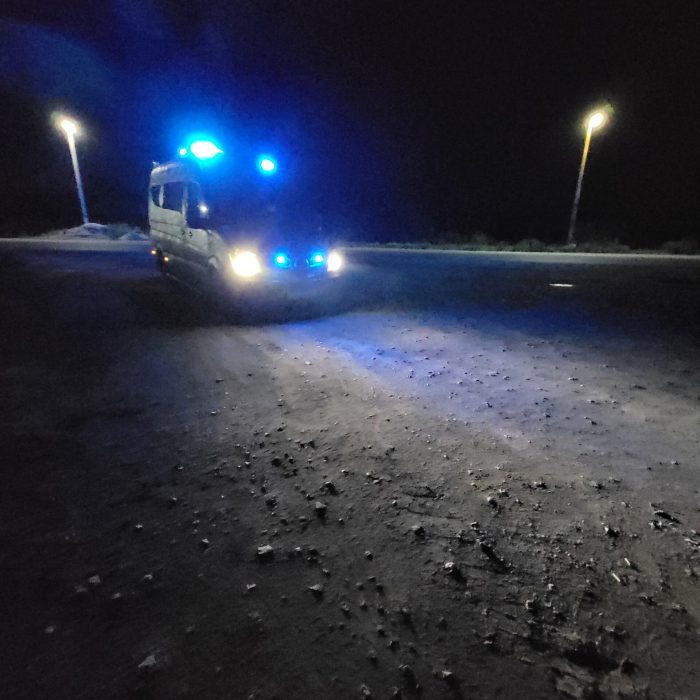
Ambulance waiting to transfer a doctor to another vehicle
In the Glare of Flashing Lights – Between Heartbeats
Immersion in the Transfer of a Wounded Soldier
« Here, you sleep when you can, eat when you can, and shit when you can. » This crude adage is the reality for the volunteers at the base. These medics, war first responders, live in a constant state of alert, in a long alternation between intervention and rest.
In the room filled with bunk beds, everyone has just fallen asleep when a phone rings in the dark. A faint blue light turns on, and the alarm stops. « Pizdiets! » It is 1:30 in the morning. In the dim light, Sacha* gets ready and heads to the kitchen.
Sacha is Ukrainian. He is a short man with dark hair and a three-day beard. In the kitchen, he is making coffee when Ericsson* enters. A former emergency doctor, Ericsson is two meters tall and bald. Behind his glasses, his eyes are still foggy from the abrupt wake-up. « Did you have enough sleep? » He asks his driver. « Yes. Mhm, maybe one hour.«
Ericsson’s group handles « medevacs, » which are military medical evacuations. With their fleet of ambulances, this group of volunteers bridges the gap between military and civilian hospitals, an average of two and a half hours away. They are based a disaffected building attributed by the government, more than 30 kilometers from the front.
The two men, dressed in dark green, step into the dark to reach the green ambulance. While avoiding the obstacles of the obscurity, Ericsson explains that the patient is an « ICU, » meaning « Intensive Care Unit. » His vitals are very fragile.
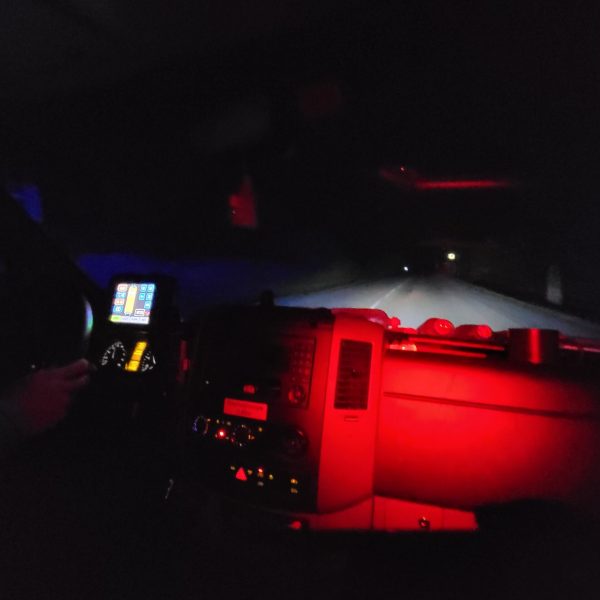
The ambulance hits the road, lights flashing. In the back, the diodes of various life-support machines flicker. Up front, Ericsson and Sacha play heavy metal to finish waking up.
The hospital is in a small town, plunged into darkness; like everywhere in Ukraine, public lighting is off. Only the almost aggressive white light of the access ramp reveals the building’s presence. Sacha pulls out the stretcher while Ericsson rushes into the hospital. The staff guides the stretcher-bearer through the dark corridors to a door from which a bright light and the beeps of hospital machines emanate.
On a stretcher lies a naked body. Eyes closed, mouth open, and intubated with multiple tubes. He is lying with his arms slightly apart, like in anatomical drawings. At this stage, photos are forbidden, as the Ukrainians want to preserve the dignity of their soldiers, especially when they are most vulnerable. The soldier must stay anonymous and his condition undisclosed.
The soldier is tall and robust, with a carefully trimmed red beard. His personal belongings, a passport, a wedding ring, and a pendant, are handed to the stretcher-bearer. Mechanically, Ericsson lifts an eyelid to check the patient’s sedation state. In a mix of English and Ukrainian, he communicates with the attending doctor.
Once the soldier is ready to leave the hospital, Sacha enters the room and positions the ambulance stretcher next to the hospital’s, and ten staff members gather around. Transferring a patient between stretchers is a muscular and delicate procedure. Placed on a canvas with handles, the body has to be lifted without dislodging any of the tubes attached to it. « Ras, dva, tri.«
With the soldier on the ambulance stretcher, Sacha secures him with straps. Meticulously, he threads them under the various cables, drains, and IV lines, taking care not to dislodge anything. His compatriot’s life depends on it.
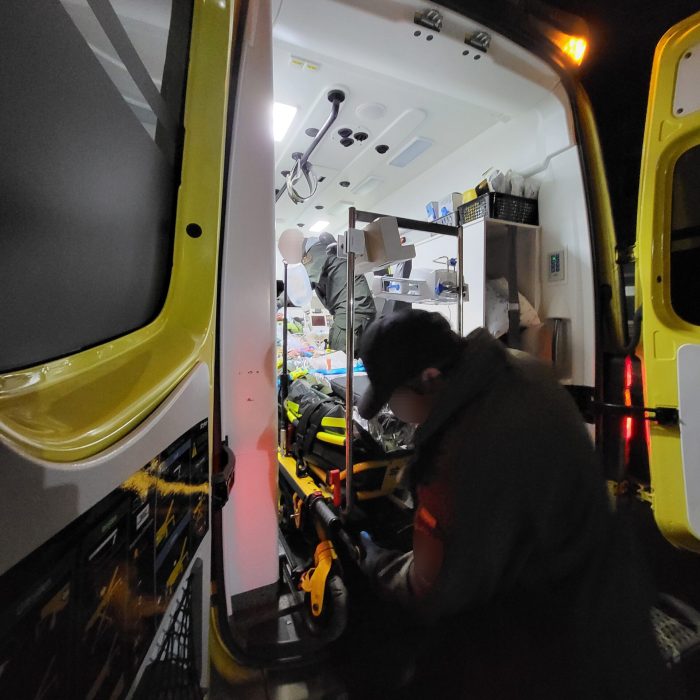
Sacha slid into the ambulance, the stretcher carrying the wounded soldier.
Leaving the hospital, Sacha slides the stretcher into the green ambulance, then takes the driver’s seat and waits. Ericsson now has to prepare the patient for transport. Meticulously, the doctor connects him to the onboard machines, attaches the IV fluid bottles to the ceiling, and fixes the oxygen supply to the oral tube.
One by one, he grabs his syringes, chooses his vials, calculates his doses, injects, discards, and notes. It is a patient and silent job, punctuated by the sounds of the various monitors and the ventilation of the respiratory assistance.
Finally, after a last visual inspection of his patient, he carefully covers him with a blanket. « Sasha, we can go. » The ambulance sets off gently, navigating the potholes of Ukrainian roads.
Throughout the journey, Ericsson notes the patient’s progress on a chart. Every drug, quantity, and injection time is recorded. At regular intervals, he checks the monitors and notes the vital signs’ evolution.
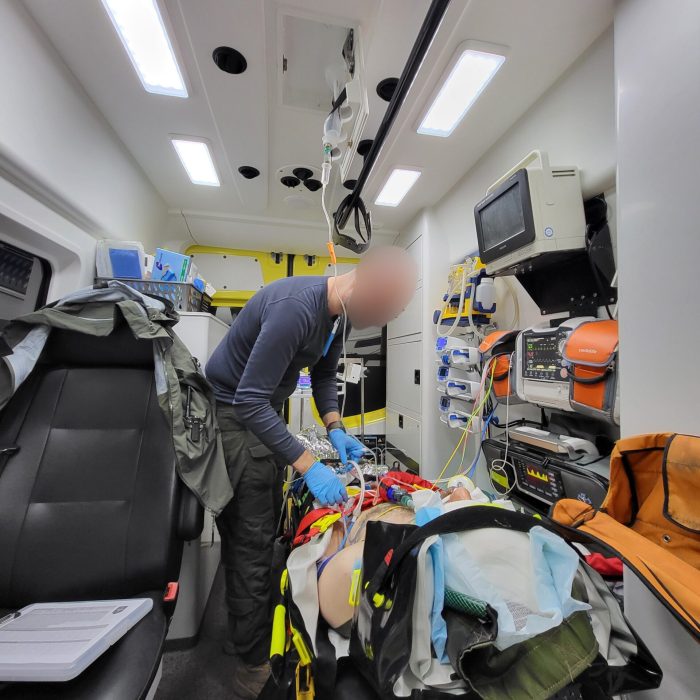
Ericsson is preparing his patient for the ride.
Except for the sound of the ambulance tires that Sasha drives at 120 km/h, calm reigns inside the vehicle. Through the side windows, the landscape brightens, and the sky gradually turns pale blue. It is four in the morning.
Sacha knows the route by heart, every pothole, every bump, every checkpoint. He drives the ambulance smoothly, making it almost forgettable for those in the cabin. With brief glances in the central rearview mirror, Sasha stays alert to Ericsson’s gestures and adjusts his driving accordingly.
The vehicle slows and turns on its siren as it approaches a checkpoint. Gradually, the rural landscape gives way to houses. The roads widen, and Soviet-era apartment blocks appear. The medical transport enters the country’s third-largest city.
The driving becomes fragmented and jerky. The ambulance navigates between the first road users, slows at traffic lights despite the siren, and is jolted by cobblestones and tram tracks. Ericsson stands up and prepares his patient for dis-embarcation.
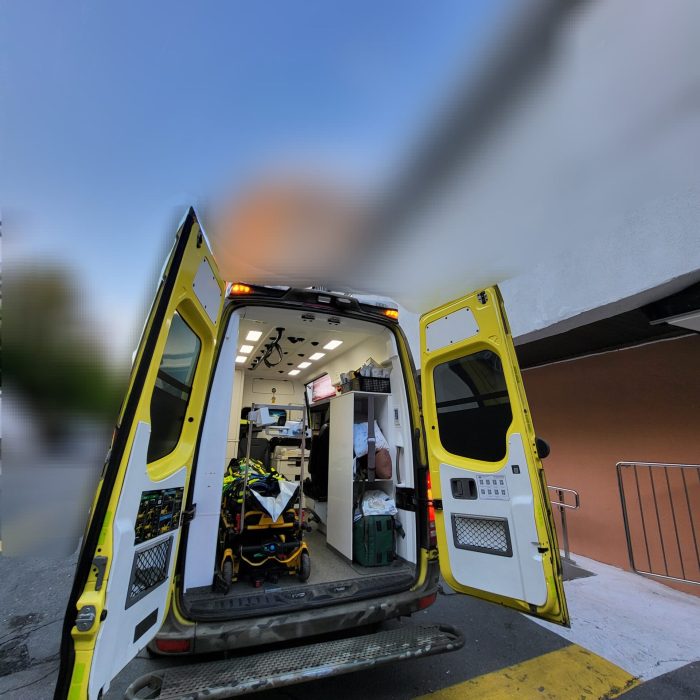
Disembarquement of the patient at a civilian hospital, at about 5 am.
Upon arrival at the civilian hospital, Sacha opens the rear doors and gently pulls out the stretcher, while another ambulance parks next to them. Another soldier, bedridden, with clothes cut off and face and torso covered in dozens of shrapnel, is brought out.
After a quick exchange of documents at the entrance hall reception, the patient is taken to the transfer room. In the blue-tiled room, another soldier lies naked on a stretcher. He has lost a leg. Severed at the upper thigh, the wound, overflowing with compresses, is closed only by a few stitches. The amputation is fresh, still stained with the orange of betadine.
Ericsson and Sacha place their stretcher next to an empty one. A nurse receives the wounded man with a tender look and connects him to the hospital stretcher’s ventilation system. While Ericsson transfers his follow-up charts to the hospital doctor, Sacha removes the transport straps. Again, ten staff members gather around the stretchers. « Ras, dva, tri. » The patient is transferred to the hospital.
While the onboard doctor continues to communicate with the hospital doctor, the shrapnel-hit soldier enters the room. He also needs a team for his stretcher transfer. The room becomes disorganized and crowded. Everyone who is not needed leaves once the transfer is completed.
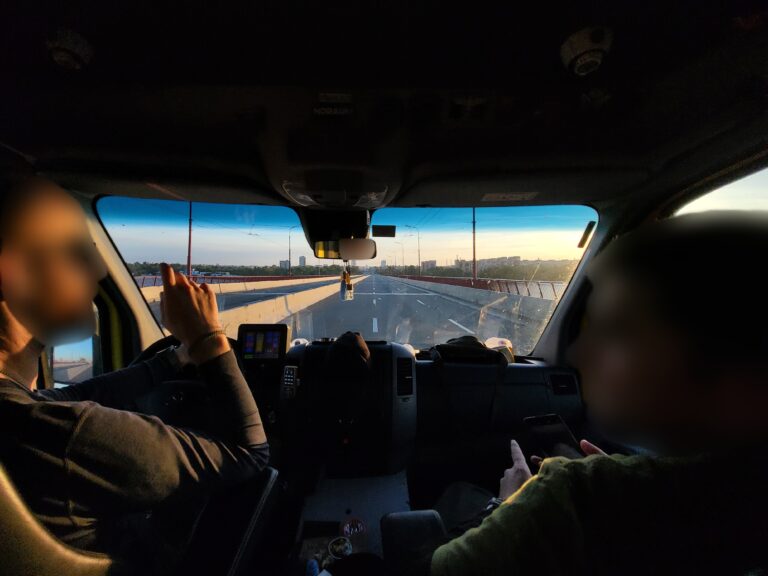
Ericsson proposed to drive back to base to give some extra rest to Sacha.
After refilling the oxygen bottles, Sasha closes the ambulance doors, and the team sets off back to their base, more than 30 km from the front.
The sun is fully up when the ambulance returns to its base two hours later. Ericsson and Sasha get out and quickly cross the courtyard of the building to find their beds. They will sleep as long as they can ; until the next intervention.
At man’s height, between the lines — Little Frenchy
20/10/2024