
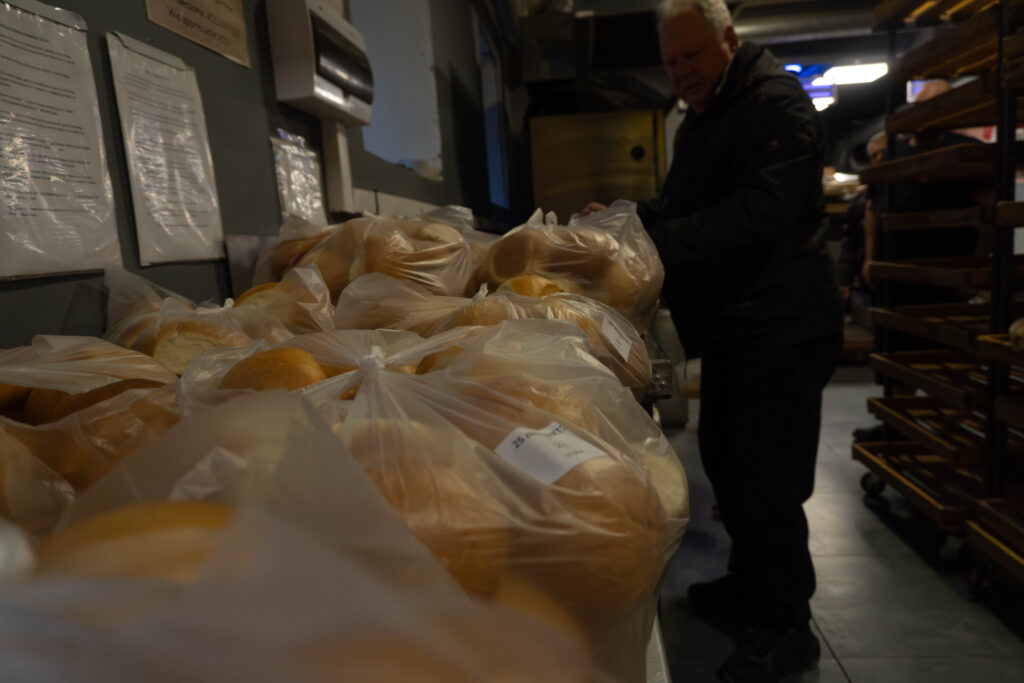
Aleksandr – or Sasha – counting bread bags and preparing his delivery, in the early morning
Feeding Despite the War
Delivery from a Volunteer Kitchen in Ukraine
It’s early morning when Aleksandr—known as Sacha to friends—prepares his coffee. Sacha is a volunteer at Hell’s Kitchen, in Kharkiv; this volunteers’ kitchen prepares meals for both civilian and military hospitals in the city. Today, Sacha oversees deliveries.
The volunteers of Hell’s Kitchen have installed their hub in a large local, in Kharkiv. In the spacious room, they’ve arranged everything needed to prepare full meals: a baker’s workbench and oven for bread, a cold station for legumes, and, in another room, a hot station for cooking. Although the space wasn’t designed as a kitchen, and none of the volunteers had worked in restaurants, they managed to equip like a full kitchen brigade. In total, about a dozen volunteers participate daily in supplying the city’s hospitals with food.
“Davaii!” Sacha’s slow, warm voice echoes through the establishment. In his black puffer jacket, he calls on the other volunteers to help load the van. At the end of the long room, in the cold room around a corridor, he points out the containers to be delivered. Buckets of soup and other hearty stews are stacked in the van alongside the bags of bread. Each batch is dated and labelled. Every hospital receives a precise delivery.
At 7 a.m., under a grey, cloudy sky, Sacha starts the engine of the black van; among the first drivers of the morning, the retiree sets off through the city streets. “I prefer to deliver early,” he explains. “There’s less traffic, and the children get their food sooner.” Indeed, Sacha’s last stop is a paediatric hospital—he is to deliver the children’s breakfast.
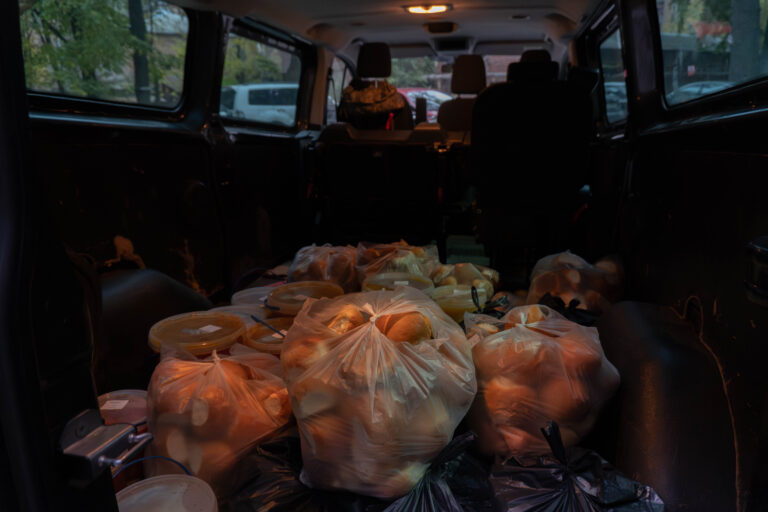
Bags of bread loafs, and buckets of thick soup stacking up in the delivery van
Before the Russian invasion, Sacha was retired. “I have worked in education, then switched to insurance,” he explains. With a pension of barely $100, Sacha kept a part-time job to supplement his income.
“When the war broke out, I was just in shock, like everyone.” Sacha went to the Territorial Defence to take up arms. However, due to his age and health issues, the military turned him away. “They advised me to do what I could as a civilian.” Determined, Sacha joined Hell’s Kitchen to support his country.
“A volunteer is someone who works for victory,” Sacha says. “Some build drones, others repair vehicles or deliver medicine to the front.” Everyone contributes according to their skills, all working towards the war effort, “even if it’s just drop by drop,” Sacha affirms.
At Hell’s Kitchen, not everyone is Ukrainian; half the staff come from Europe and English-speaking countries. “I’m very grateful to the foreign volunteers, for their time and commitment alongside us,” Sacha concludes.
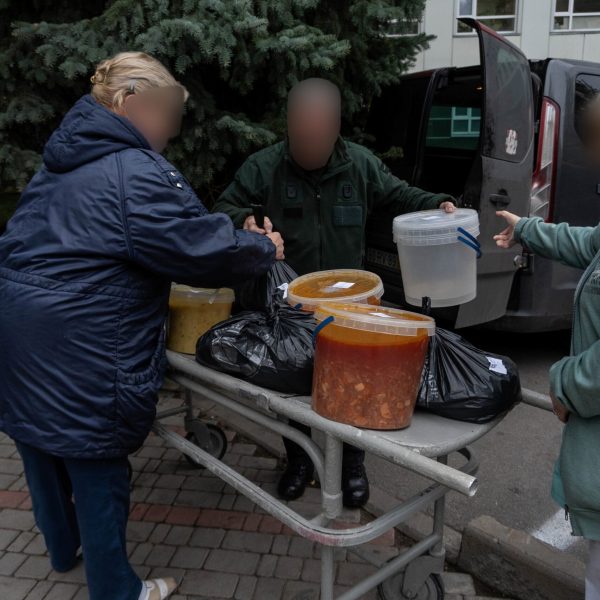
Hospital nurses receiving the delivery with a gurney
At the first hospital, two nurses come out with a hospital gurney. Sacha circles the van, opens the rear doors, checks the labels, and places the correct packages on the metallic stretcher.
After a few warm exchanges, the nurses pose with the delivery, and Sacha photographs them with his phone. For the volunteers, the photos aren’t just for social media—they serve a contractual purpose as proof of the transaction. “Ok, now, we go,” Sacha announces, getting back in the van.
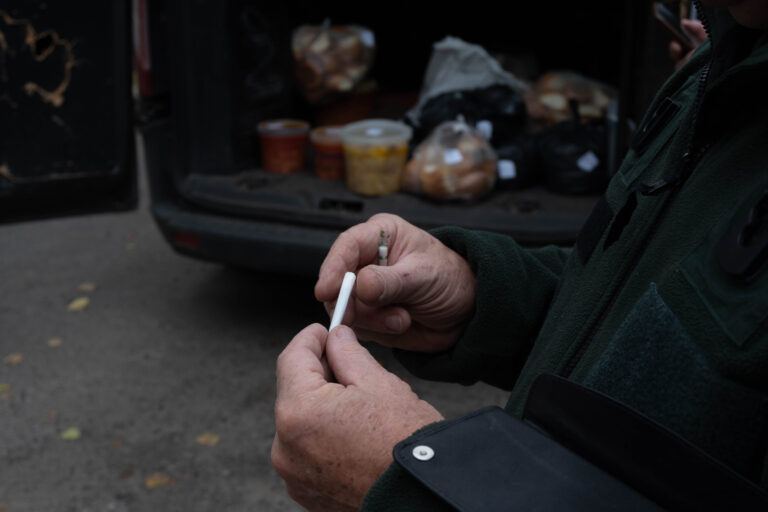
Rolling his cigarette, the volunteer accompanying Sasha waits for him to finish handing out food
The retiree continues through the city’s streets, past early 20th-century buildings with pastel facades, horizontal bands, and white window frames. At every turn, they mingle with buildings of Soviet brutalism and post-modernist glass facades.
Around a corner, Sacha parks in front of an unmarked building. “Next stop is soldiers. No pictures there, OK?”
The volunteer unloads the packages at the entrance and knocks. A man in civilian clothes comes out and shakes hands with Sacha. This time, the contractual photo only frames the staff’s feet and the pavement.
In this drone-era conflict, where the fog of war is vanishing, the armed forces must constantly camouflage and hide. Nothing escapes Russian strikes. Military clinics are no exception, and many medical facilities are forced to conceal themselves; risking being targeted—a situation contrary to international humanitarian law.
“Ok, let’s go,” Sacha concludes. The black van resumes its route, returning to the city’s wide streets as traffic thickens with the morning.
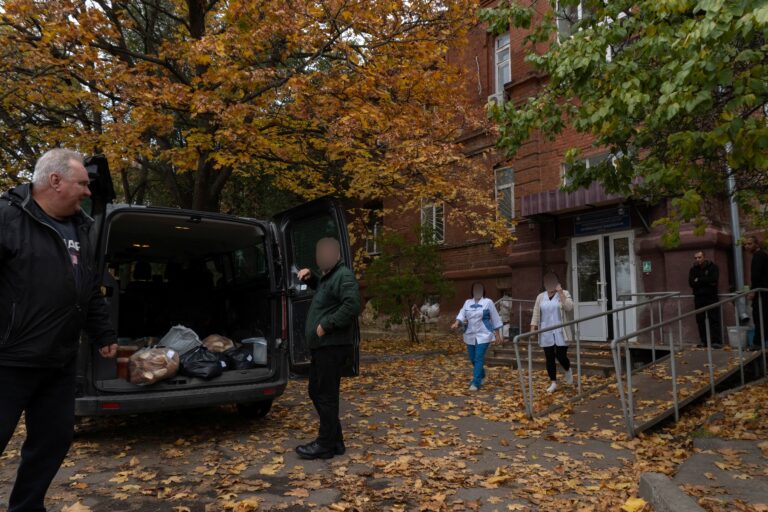
“There will be, erm, two beautiful nurses,” coming out of a hospital to meet the volunteers
“There will be, erm, two beautiful nurses,” jokes Sacha, parking his van in front of a hospital with large red bricks. Smiling, two nurses in white coats with bobbed hair come out to greet the volunteer. Sacha prepares the bags for them.
Questioned about the provided help, the nurses explain they partly depend on the volunteers’ kitchen. “We work in a medical facility, and the volunteers’ help with food is really important for us. It helps us support our fighters. We have our own kitchen, but it’s not quite enough. This volunteer kitchen is very useful for us, and we’re grateful.”
In a country at war, scarred by high-intensity operations, the state is forced to make choices. “I think there isn’t enough funding,” one nurse says. She adds that the hospital has relied on volunteer help since the start of the conflict. “With Hell’s Kitchen, our hospital has been like this from the very beginning.”
The war affects not only hospital funding but puts all services under strain. In addition to “normal” patients, staff must care for civilians wounded by shelling. The sheer number of casualties also means that civilian hospitals must care for soldiers, who come with both physical and psychological injuries. The nurses agree. “Yes, I agree with you, I’m sure that’s the case. Yes, a very large number of patients too, it’s also because of the state of the country itself.”
Whatever it takes, for these nurses, it’s about holding on and caring for patients in a war that has taken over their daily lives. “It’s hard to give advice (about our job), because we live with (the war) and it’s with us every day. Every day, we’re with the patients.”
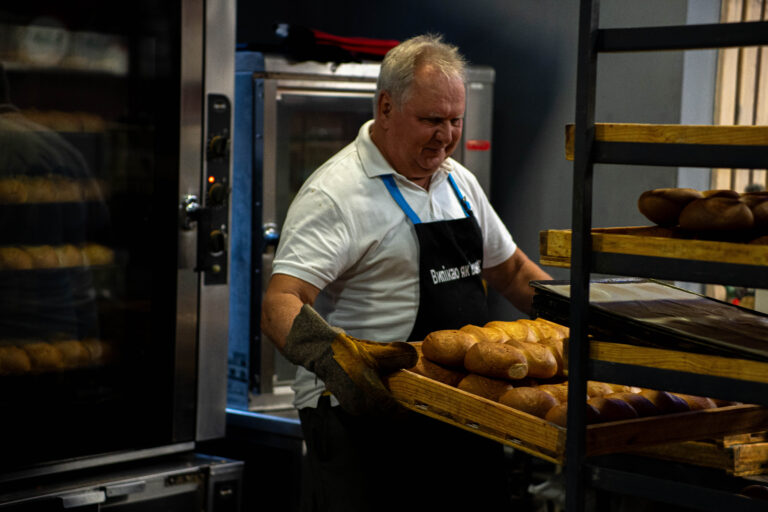
Sasha, taking loafs out of the oven at Hell’s Kitchen
Sacha finally arrives at the paediatric hospital. Here, he goes straight to the kitchen. The cooks are happy to see him. It’s 9:30 a.m.—the delivery is on time so the cooks can prepare breakfast for the children. Sacha seems satisfied; the children will get their breakfast on time.
At man’s height, between the lines — Little Frenchy
08/12/2025