
image description
The Wrath of the Kremlin
A Night of Retaliation in Kharkiv Following the June 1st Attack
It is a long, piercing wail that awakens in the middle of the night. Sharp and crescendoing, like the sound of an airplane stalling. The noise persists and draws closer before giving way to a loud explosion. It is 3 a.m. in Kharkiv. Moscow’s retaliation for the June 1st attack has begun.
On June 1st, the SBU, Ukraine’s intelligence service, launched several synchronized attacks on multiple Russian military airfields. Using FPV drones, Ukraine destroyed or damaged a third of Russia’s strategic aviation capabilities. The Kremlin had warned of severe reprisals against Ukraine. It took them six days to organize.
In Kharkiv, the relentless bombing of the city began shortly after 3 a.m. Pounded by Shahed drones, the city endured two hours of the Kremlin’s retaliation for Kyiv’s attack on Russia’s strategic aviation, responsible for carrying its nuclear fire. Many observers described the operation as humiliating for Russia, as coming from a non-nuclear state.
The Shahed drones, of Iranian manufacture, are large loitering munitions akin to « low-cost » cruise missiles. With an estimated unit cost of $20,000 for a military payload of 30 to 90 kilograms, the 200-kilogram drone has become Russia’s primary weapon for targeting Ukrainian cities. By the early morning of June 7th, some 53 drones had been fired at the country’s second-largest city in two hours, averaging one drone every two minutes.
This drone has a distinctive feature: its noise. Its propeller engine gives it a unique acoustic signature. In transit, it sounds like a moped or a distant truck. Once it reaches a given GPS coordinate, the loitering munition begins its descent toward the target. The noise then rises in pitch and crescendos as the device approaches. Often equipped with a so-called « thermobaric » warhead to maximize damage, the detonation is aggressive.
However, according to official figures, these low-cost missiles cause more material damage than casualties. So much so that some people complain about them as they would about mosquitoes in summer. That said, the long, piercing scream, lasting up to a minute, makes it a formidable psychological weapon. The Shaheds wake the population in the middle of the night without them understanding where the drone will end its course.
In the city centre, residents are jolted awake by the drones, which seem to trace their sinister paths in all directions. From unknown positions, lost in the city’s darkness, the bursts of heavy anti-aircraft machine guns follow one another. The cycle is almost the same for each drone. The shrill descent begins, and its imminent arrival at the target is guessed by the intensification of machine gun fire. Starting with bursts, the cannon fire turns into a sustained barrage, reflecting the shooter’s desperation. Then, the drone’s detonation gives way to silence again as the echo fades into the night.
The Kremlin’s reprisals seem endless. Drone after drone, the city seems to crumble under the reverberation of munitions. Around 4 a.m., the alarm finally sounds. Initially, it might seem ironic given its delay; the entire population is already well aware that a massive attack is underway. Then, several larger explosions surprise and resonate throughout the city without warning. By morning, residents will learn that four KAB bombs and a cruise missile struck the city.
The alarm stops, the cycle of Shahed drones and machine guns resumes as the night sky pales and gives way to dawn.
In a relatively rare occurrence, many Ukrainians sought refuge in the corridors, stairwells, and basements of their buildings. For a population accustomed to bombings, this illustrates the intensity of the attack. At regular intervals, some emerge from their shelters, smoke a cigarette to calm their nerves, check their phones to try to reach their loved ones, before returning to safety.
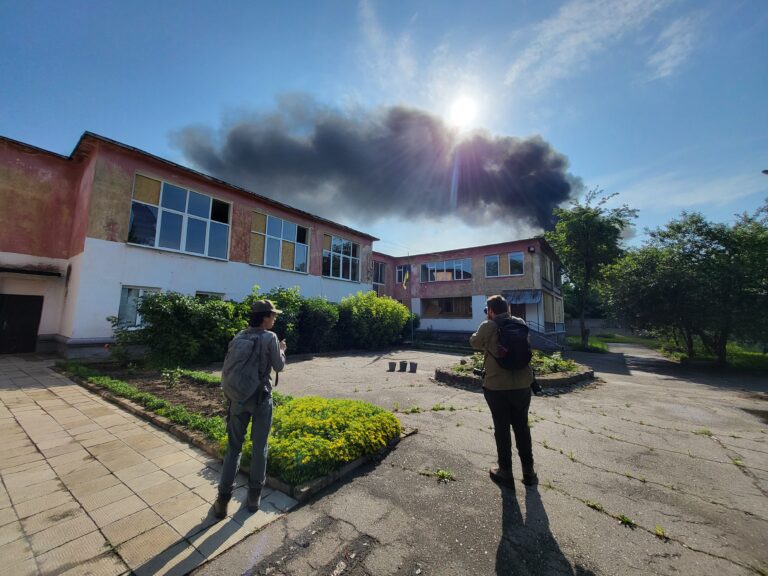
image description
At 5 a.m., it is almost no longer night. The intensity of the attack has decreased. Everyone awaits the last detonation, often with a cigarette in their mouth and a phone in hand. At 5:30 a.m., the city’s Telegram channels announce the end of the alert. Everyone leaves their shelter to return to bed. But not all. According to the mayor, eighteen buildings and thirteen houses were hit. By noon, authorities will have counted twenty-three injured and three dead.
At 6 a.m., under a cloudy sky and light rain, a significant part of the city is covered in thick dark smoke. In the northeast of the city, the former Kharkiv aircraft manufacturing plant was heavily hit. Firefighters are working to control the blaze. However, as the site is military, the press is not allowed. Elsewhere in the city, public services have also been deployed. Everywhere, buildings and private homes have suffered the Kremlin’s relentless assault.
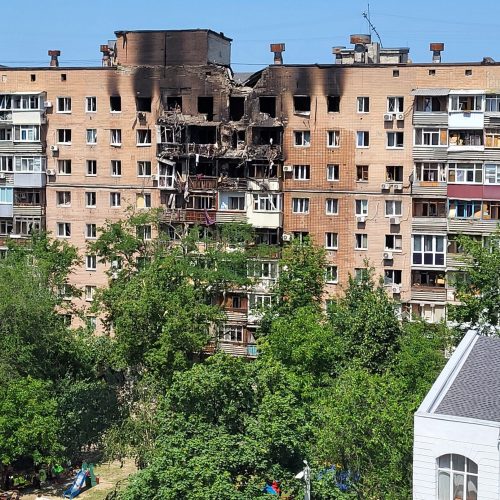
image description
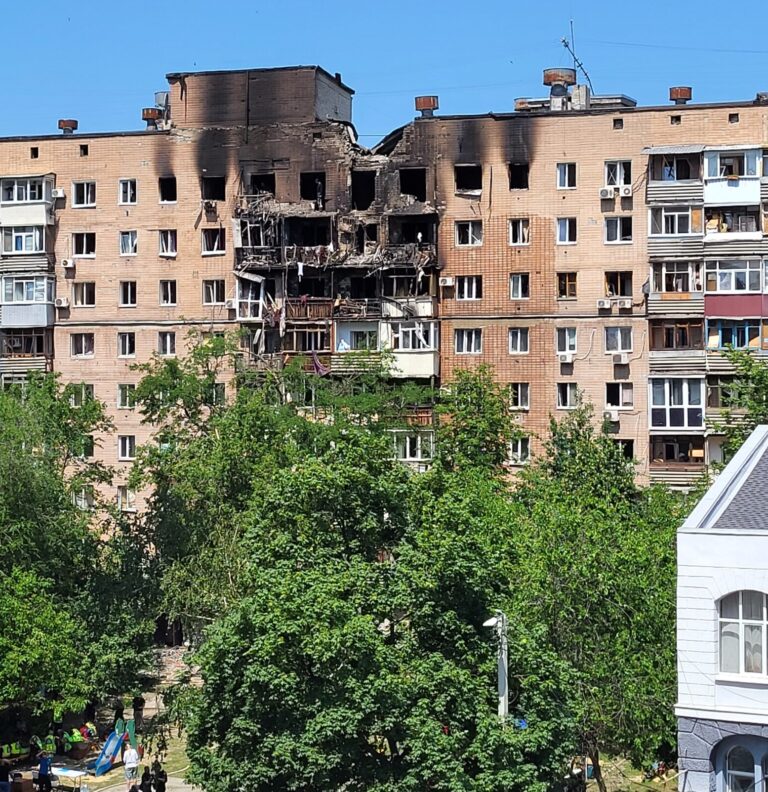
At 10 a.m., public services are at work in a building near the city centre. Hit on the eighth and top floor, the roof has given way to a gaping, charred hole. The fire has been under control for a few hours, and firefighters are busy throwing burnt objects and unstable fragments of the structure into the void. At the lower windows, residents are tidying up their homes, sweeping up, and disposing of the shards of blown-out windows.
At the foot of the Soviet-era building, debris thrown from various windows of the stairwell accumulates. Around a security perimeter marked by red and white tape, firefighters, police, and soldiers ensure the progress of the work. A crowd of journalists mingles with volunteers preparing wooden planks to cover the windows.
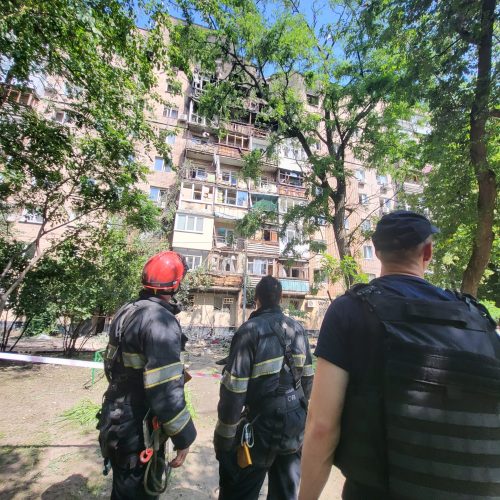
image description
In an adjacent stairwell, a blonde woman in her forties agrees to testify in Ukrainian. « There was a martyr’s fusillade last night. Many people were injured, and the children had an acute stress reaction. Well, the services helped, we have already somewhat recovered. We have calmed down…«
The moment of the strike took the entire stairwell by surprise, and the residents were caught off guard. The woman describes the moment of impact. « Of course, it happened at night at 3 a.m., it was very scary. We didn’t know what to do at first, we heard the sound of the Shahed resonating very loudly. Then, suddenly, there was an explosion. The lighting was so bright! We all ran to hide, we all ran out of here to the entrance, the whole stairwell. People started to panic, looking for some kind of shelter. Well, we all stuck together.«

image description
The resident describes hearing a very loud noise rapidly approaching her home. Even from the stairwell, « it was piercing in the ears. » The explosion was instantaneous. It was a scene of great fear that gripped the neighbourhood in the middle of the night, with evident violent confusion. « The first thing that followed the explosion was the sound of breaking glass, very audible, and the screams. People started running out of the apartments towards the entrance. And we all went out. There was so much smoke, fear, shock.«
Reassured by the quick intervention of public services, the resident assures that their response was appropriate and effective. « The services have already helped us. They did everything. They saved everyone. The only thing really damaged is this house. So, thanks to all the services and the mayor of our city for their quick intervention. They provided all the necessary help, and even more.«
By late morning, as the fires are under control and volunteers are already preparing wooden planks to cover the windows, a resilient population rises from yet another drone strike.
At man’s height, between the lines — Little Frenchy
07/06/2025