
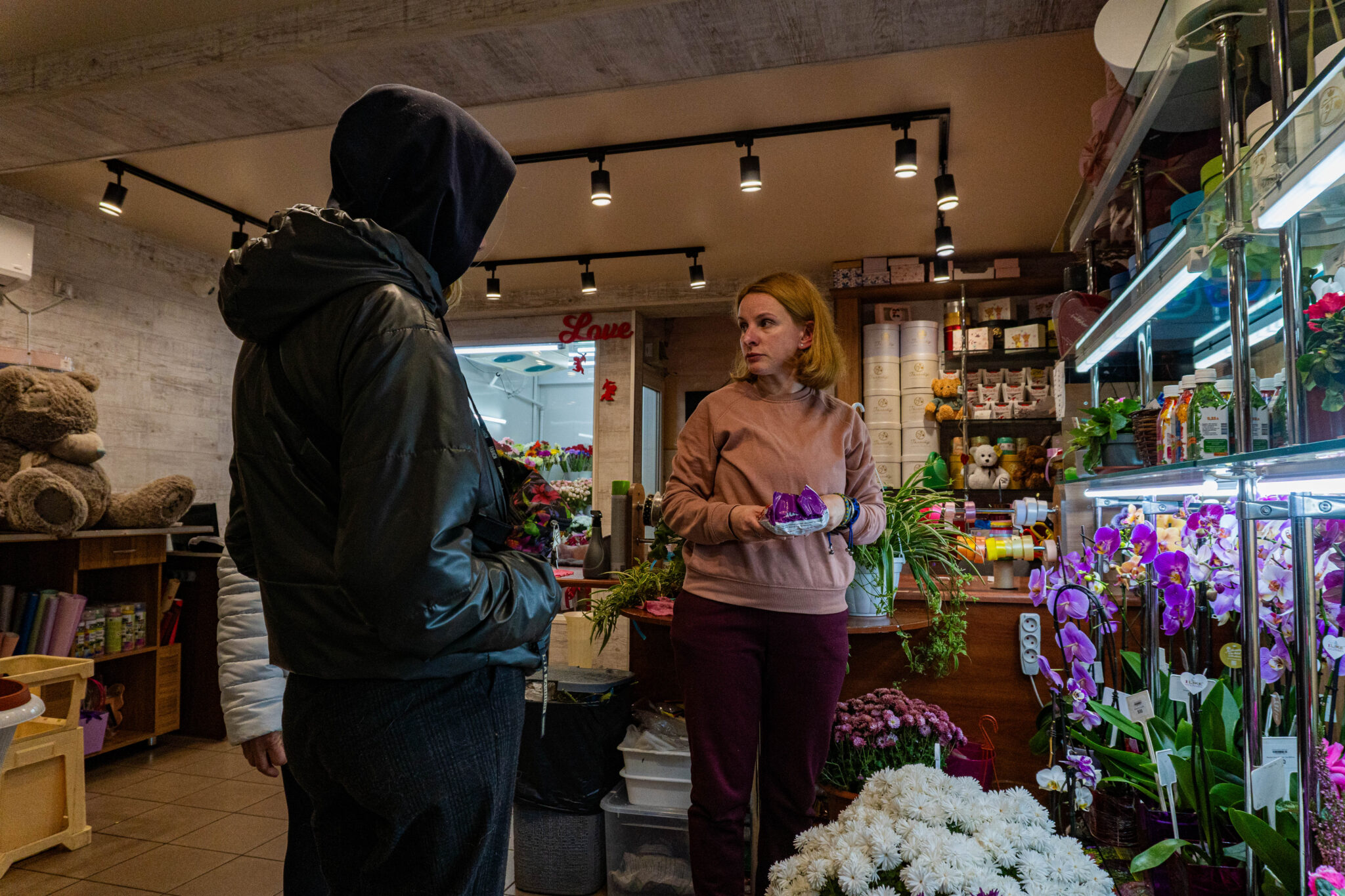
Natalia answers a client at the flower shop.
Somme Flowers Between Two Rotations on the Front
Testimony of a Shopkeeper in a Besieged City
Natalia is a sales assistant in a flower shop in Kramatorsk, where she was born in 1985 and has lived her entire life. As an active shopkeeper, she recounts the daily life of a besieged city — a life shared between soldiers and civilians, punctuated by explosions.
In Kramatorsk, Natalia describes a commercial routine that could resemble an ordinary life. “There are days when it’s calm, and then there are days when you don’t have a moment to breathe,” explains the florist. Except that most of her customers are soldiers.
“Soldiers come to buy flowers for their loved ones, or for the women they are flirting,” Natalia says. The shop she works for is well known in Kramatorsk, and its clientele is loyal. “For some soldiers, it’s been a year, even a year and a half, that they’ve been buying their flowers here,” she notes. Indeed, before the railway station closed in early November 2025, it was customary for soldiers to wait for their families or partners on the platforms, holding large bouquets.
From her shop, Natalia has a front-row seat to the soldiers’ romantic lives, which she comments on with affection. “Once, there was one who spent 12,000 hryvnias!” (around €240). “It was for a very beautiful press officer from his unit,” Natalia recalls. However, the officer had lost a boyfriend in the war, and this soldier was not the only one sending her flowers. “I doubt his advances went anywhere,” Natalia concludes with a small smile.
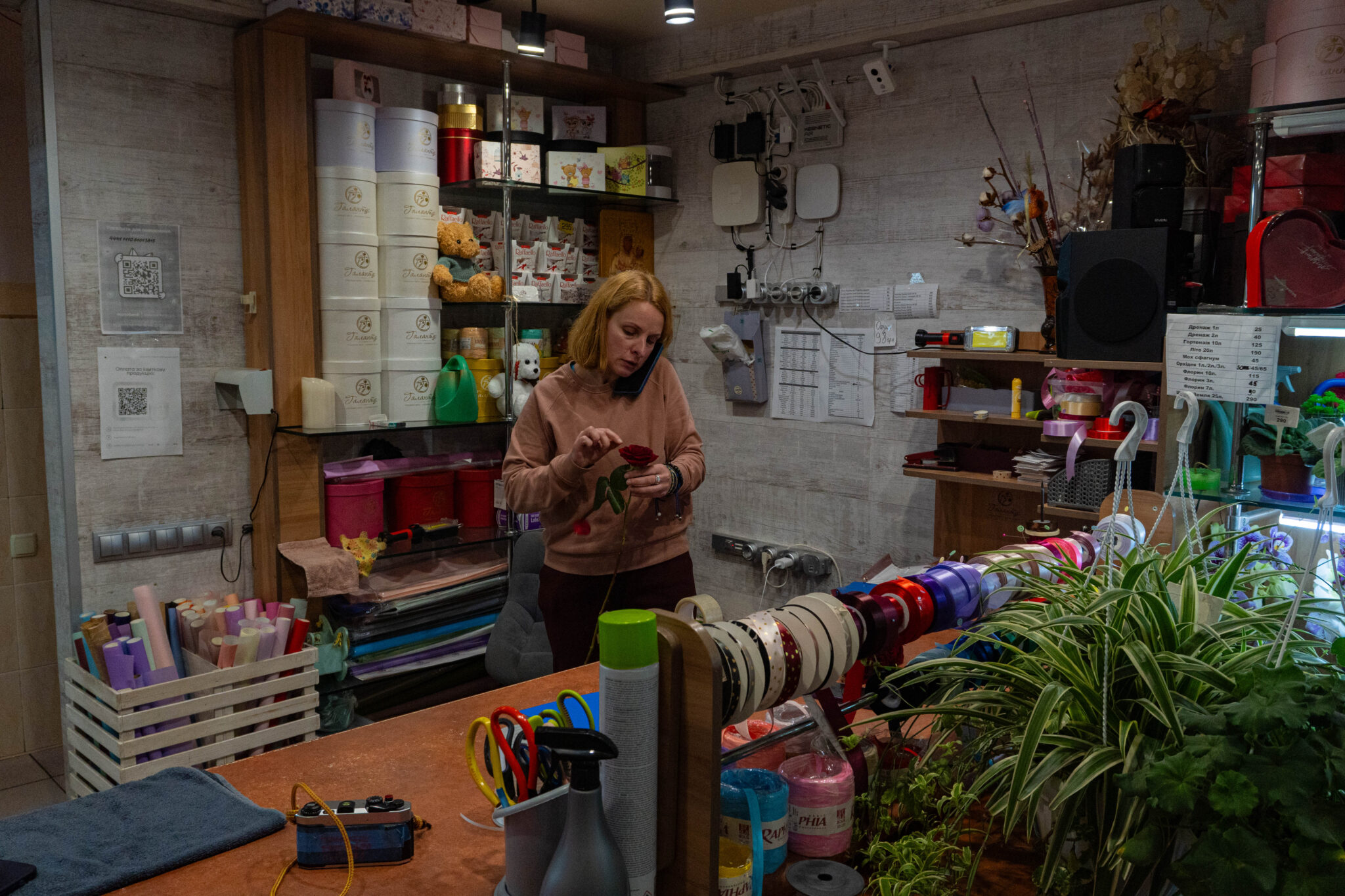
Natalia arranges a small bouquet of five flowers — in Ukraine, even numbers are meant for the dead.
Alongside her fondness for the soldiers’ love stories, Natalia is far more critical of the habits of Kramatorsk’s civilian and military population. For the florist, the situation in her city has forced her to adapt her lifestyle and behaviour. “Since the beginning of the summer, I’ve stopped going to restaurants, for example,” she says.
According to Natalia, crowded places should be avoided, as they represent prime targets for the Russians. “Going to places where there are lots of civilians and soldiers mixed together is a bad idea,” she says, “but people haven’t learned since the Ria pizzeria bombing.”
On June 27, 2023, a Russian missile struck the Ria pizzeria in the city centre, a restaurant known for welcoming soldiers and journalists. The attack killed 13 people and injured 65 others. “And yet there had already been three strikes in the surrounding area. That should have warned us, but people kept going there,” Natalia believes.
In her view, the establishment should have been shut down. “Too many civilians and soldiers died.” And yet, even today, the main customers of the city’s cafés and restaurants are soldiers fighting in the area. For the military, it is a way to break the monotony of military life and unwind between rotations on the front. “Who is to blame?” the florist asks. “The Russian strikes, or people’s choices?” — while Russians are known to strike without discriminating between their targets.
According to Natalia, a balance must be found between living and hiding. “Restaurants shouldn’t be closed. I think they can operate, but only as take-away,” she explains.
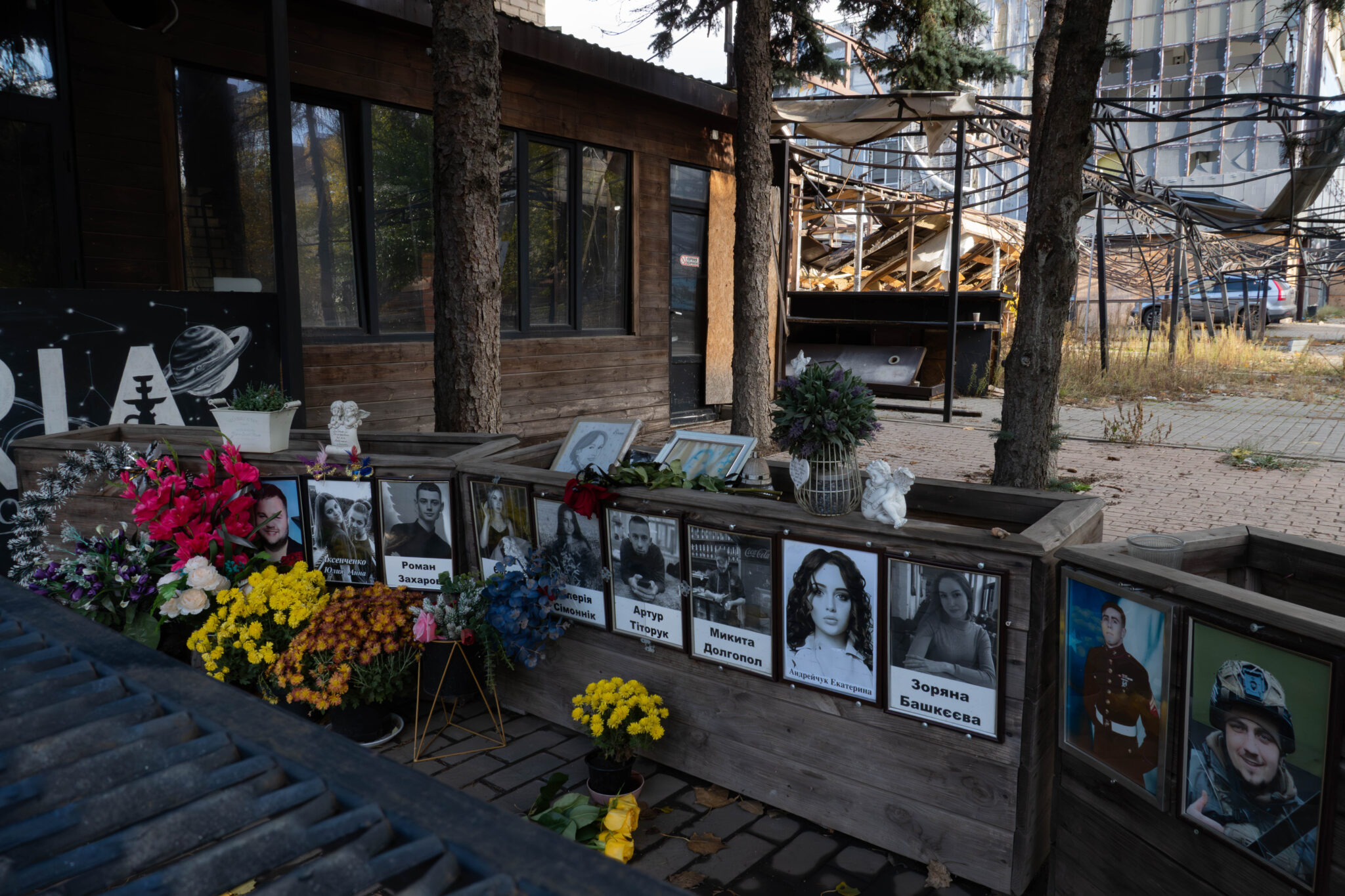
Memorial at Ria Pizza, a place once popular with journalists and soldiers.
“Everything can reach Kram now,” Natalia says, referring to the various munitions within range of the city. “Staying here means signing up for a risk of death, and civilians should leave, but people remain unconscious,” the florist continues. With her partner, a volunteer, Natalia has already had to move twice because of strikes on the city centre. “We move from strike to strike.”
Originally, Natalia lived in one of the city’s Soviet-era apartment blocks, on the ninth and top floor. “It’s on the path of the missiles targeting the city’s water treatment plant,” she explains. “Sooner or later, it will be hit,” the florist predicted. Which has since happened, after our interview.
Natalia had to accept leaving the apartment where she was born to move in with her partner in the very centre of the city. Trying to reduce the risk, she narrowly escaped a Shahed drone. “It hit the tree right in front of the building,” the florist recounts. The couple was in the stairwell when they heard the distinct sound of the drone diving toward its target. “That sound is more frightening than seeing the drone. It triggers a primal, animal fear; you just want to hide,” Natalia says. The explosion then becomes a relief — the relief of being alive. The couple then went around the building to help residents; no one was injured that time.
Now, Natalia and her partner live on the outskirts of the city. Although her new neighbourhood is within range of fibre-optic FPV drones, the florist believes the risk of being hit is lower. “There are only houses; people and cars are more spread out, which attracts less attention,” Natalia concludes.
Natalia and her partner are going through their apartment after a nearby Shahed strike.
For Natalia, “Russia is a poor and evil country.” She wants to tell Europeans that “whatever Russia says about culture and values, it’s bullshit.” Born under the Soviet era, she recalls that “people who created something, or contributed to the Soviet project, ended up in gulags” once their service was no longer needed — like the Abalakov brothers, Stalin-era mountaineers.
“Ukraine wants neither Russia nor occupation. We just want to be free,” concludes this woman who, in 2014, marched in the streets of her hometown against its occupation by separatists.
At man’s height, between the lines — Little Frenchy
Article's gallery
image description
At man’s height, between the lines — Little Frenchy
27/04/2026