
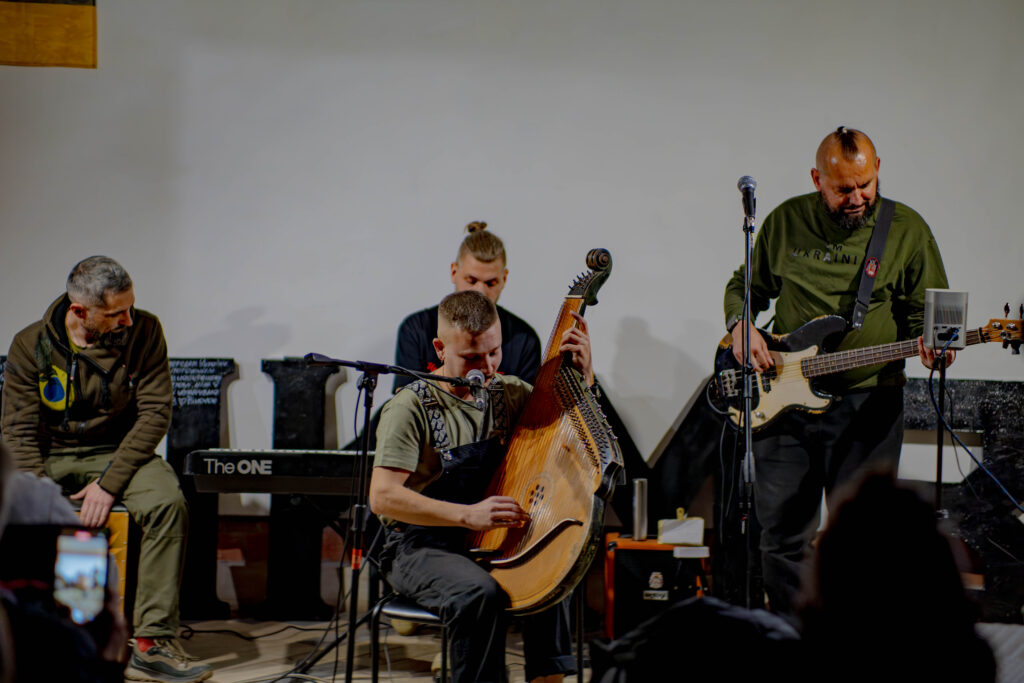
Band of military musicians playing for soldiers in Kramatorsk
Fighting Through Art
Interview with a Group of Military Musicians
Ukraine is facing Clausewitz’s “total war.” For Ukrainians, Russia seeks to erase their country’s identity. As a result, Ukrainians are mobilising all their resources to fight, including art.
“Ok, now, put telephone on airplane mode, OK?” Following the soldiers, we enter the basement of a private establishment. Around thirty civilians and soldiers take their seats in rows. It’s a large gathering in one place; the soldiers worry that so many phones might attract the attention of Russian surveillance drones.
Bogdan*, Vacil*, Lev*, and Yuriï* are military musicians; tonight, they are organising a private concert. Whether in uniform or jeans, their mission is the same: to provide moral support to troops engaged in combat.
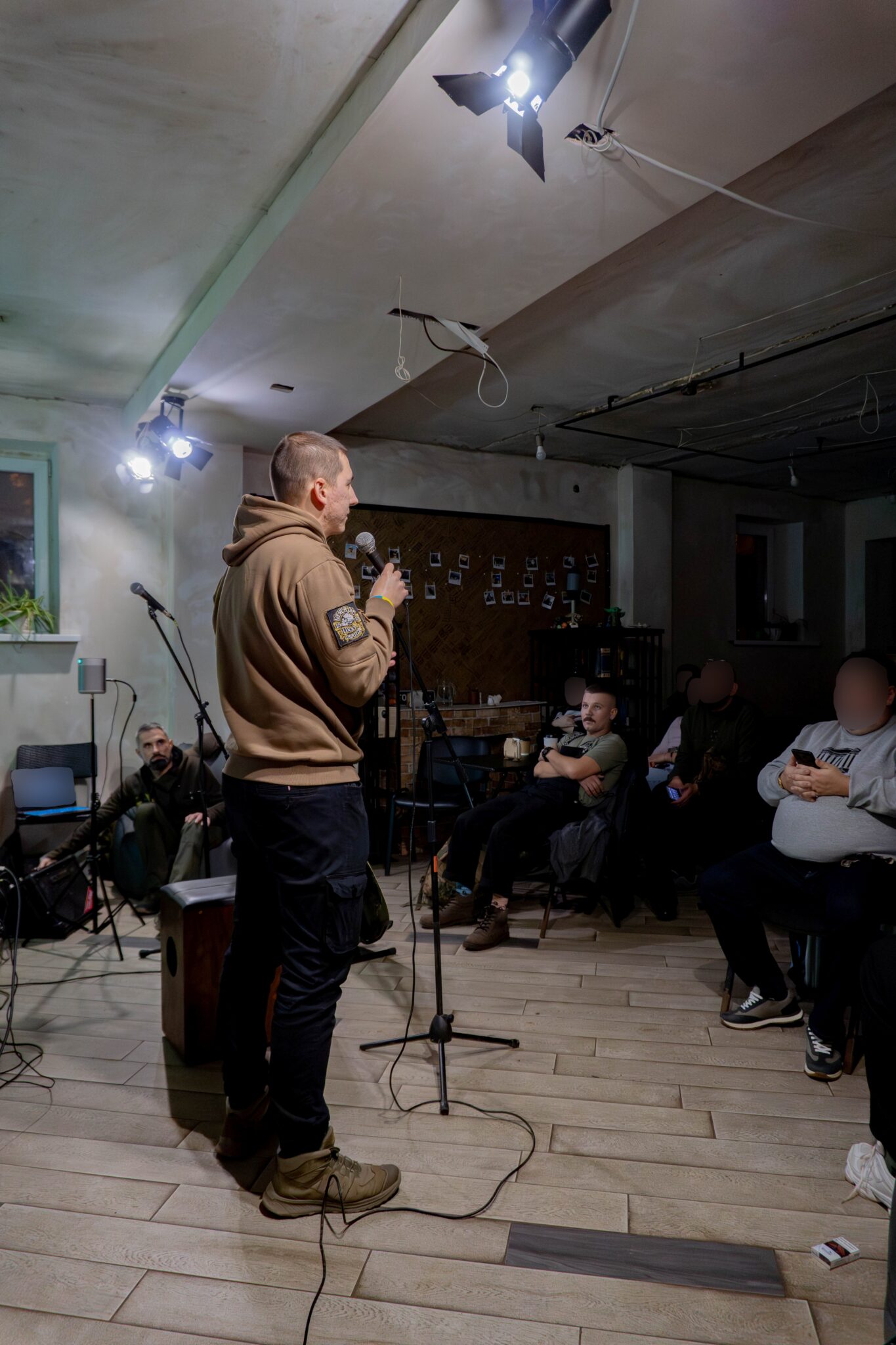
Musicians are receiving their public in the basement of a private establishment
The four musicians are part of a unit dedicated to culture. Within their brigade, their job is to organise concerts for soldiers. These gatherings allow military personnel to meet and connect with others in their brigade. “Culture is a social glue,” the musicians explain.
During these events, the group tailors its repertoire to the audience. “We have our own compositions, focused on current events,” but they also perform popular songs, “and the soldiers can join in and sing with us. It brings people together.”
Their work is part of psychological support for soldiers, who “are exhausted. It’s been four years of war.” The musicians understand the importance of their task, because “if our soldiers didn’t have the morale to fight, we would have already lost.”
Maintaining morale on the front, cut off from civilian life, is not easy. “Even though we’ve lived through worse situations than the current context, morale is low right now,” the musicians admit. “So we help them find that there is still joy in life.”
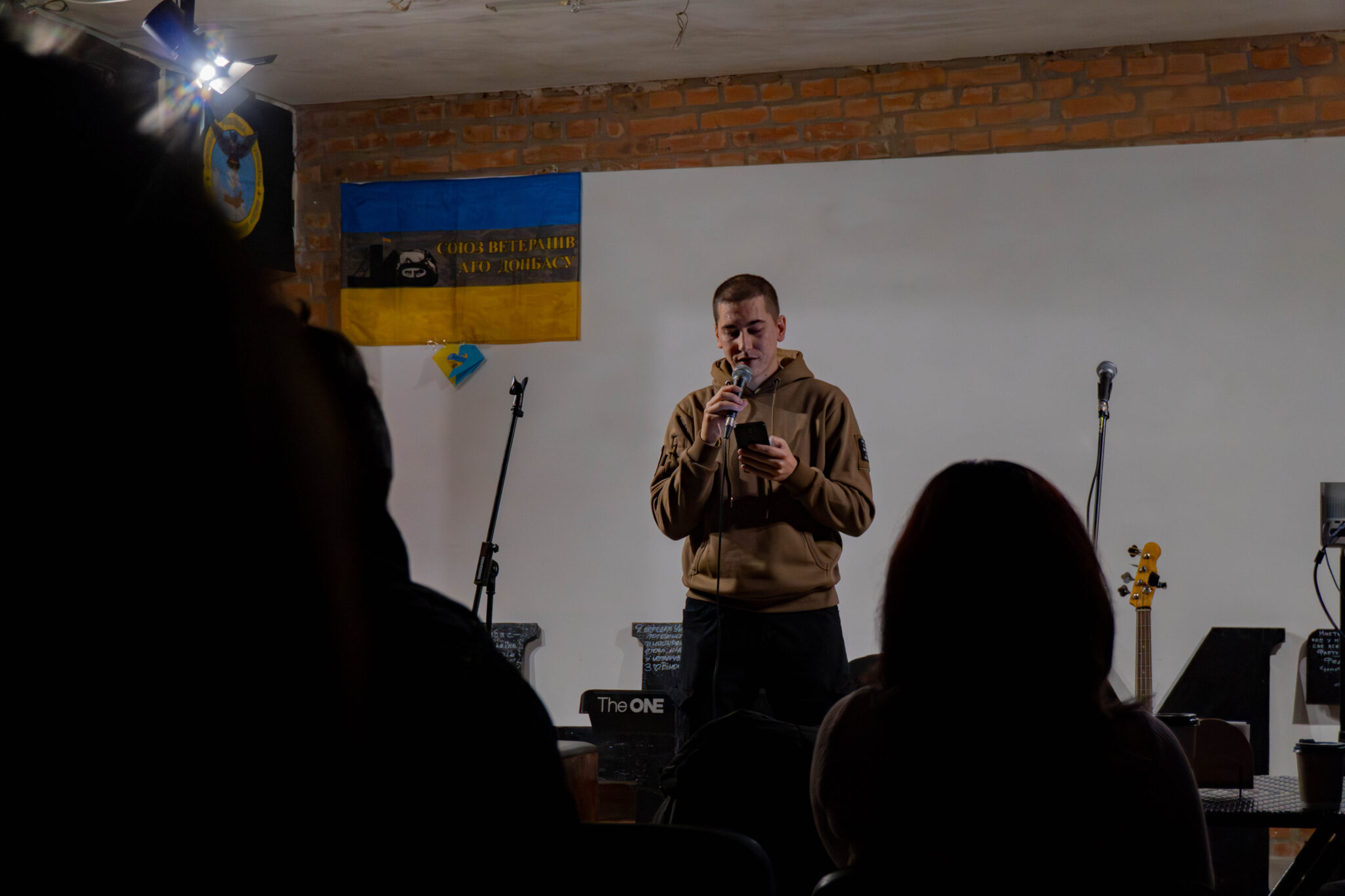
Soldier from the band presenting his poem to the public
The musicians explain that their work is divided into three areas. First, music “brings a bit of everyday life” to soldiers. “At home, we often have gatherings where we sing.” But when mobilised, soldiers are far from their families, “they don’t see their children grow up.” Concerts thus remind them of home.
“Music reminds them of who they are,” the musicians elaborate. “Now, with conscription, soldiers are ordinary people placed in this reality (of combat) by war.” However, they assure that “give a Ukrainian a shot, and they’ll start singing!” Bringing music to these soldiers, making them participate, is a way to give back a piece of the “civilian life, that Russia took from them; which they have lost in the trenches. (If unattended, this loss) is a victory for Russia.”
Secondly, “art is a vector of resilience,” the musicians affirm. “The medium depends on each person; for some it’s icons, for others it’s writing, or poetry.” In any case, the musicians notice that soldiers turn to art.
On combat positions, soldiers compose, “because it helps them find meaning,” says the music group. “They start writing,” composing poems and songs. “Often, they ask us to bring them books. Because they feel they’re getting dull sitting in the trenches.”
Finally, “we link our music to history,” the music group explains. “Because there is no nation without art.” Through this, the musicians show the cultural differences between Russia and Ukraine. “And they are often surprised, because many ignore the cultural richness of our country.”
And these soldiers, the musicians assure, are interested in the Ukrainian perspective on history. “They feel that their father’s identity was stolen (by the USSR), now they seek to reclaim it.”
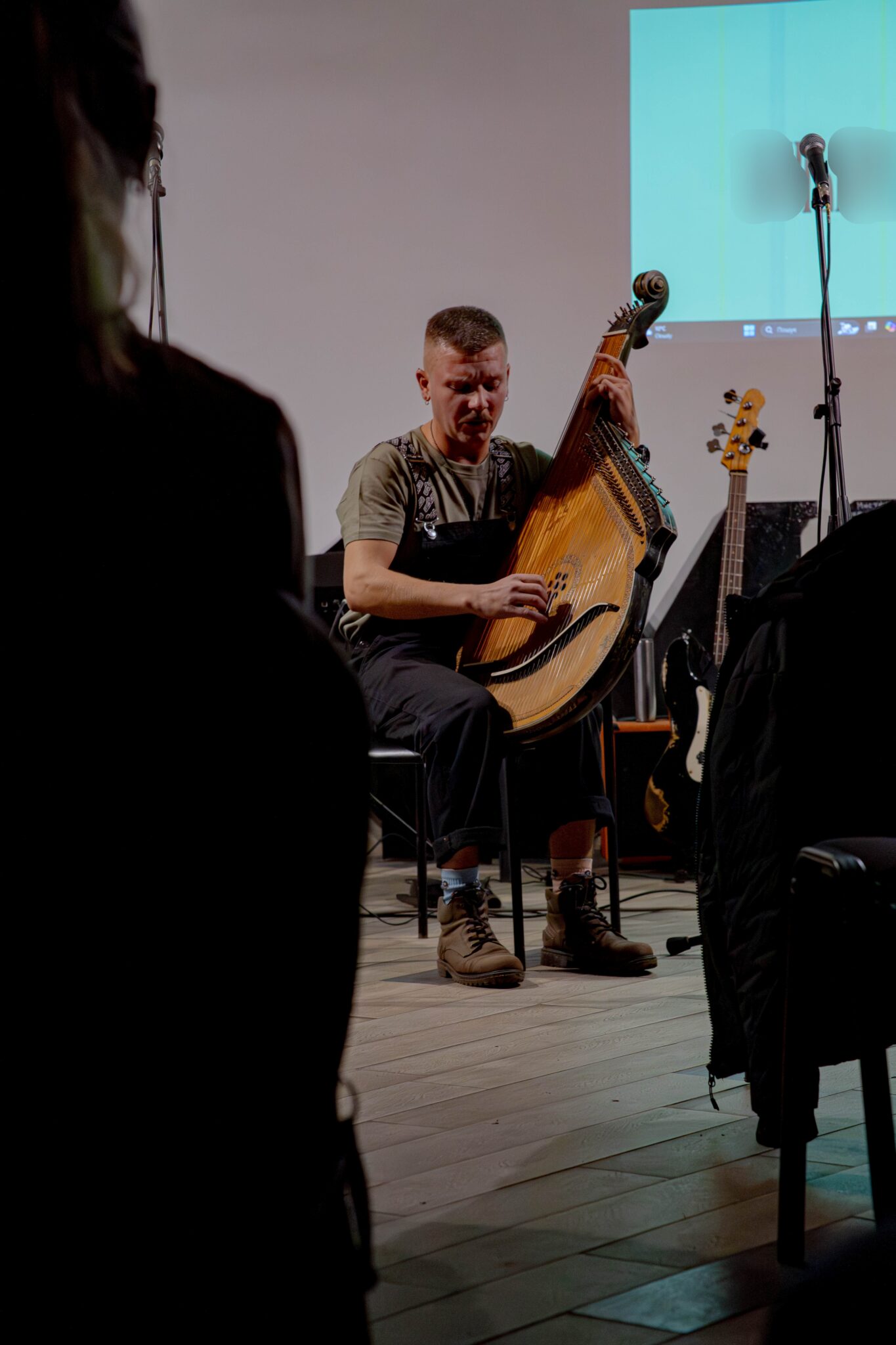
The bandura is a traditional instrument of Ukraine; “when we play the Bandura, it awakens the souls of Ukrainians” – soldier from the band
For these artists, Russia is guilty of cultural colonialism, through the occupation of Ukraine by the USSR. “Gogol, the famous writer, was from Poltava (a city between Kharkiv and Dnipro). Yet everyone thinks he’s a Russian writer!”
Gogol is not the only one subject to this appropriation. “Take the painting ‘The Zaporozhian Cossacks Write a Letter to the Sultan of Turkey,’ the painter was Ilia Repin,” a painter born in Chuguyev, a city near Kharkiv. “Yet, this painting is now in Saint Petersburg!”
“Our culture was constantly oppressed, russified without us even realising,” state the musicians. “Today, we are pursuing a process of decolonisation. We are rediscovering and reclaiming our artists.”
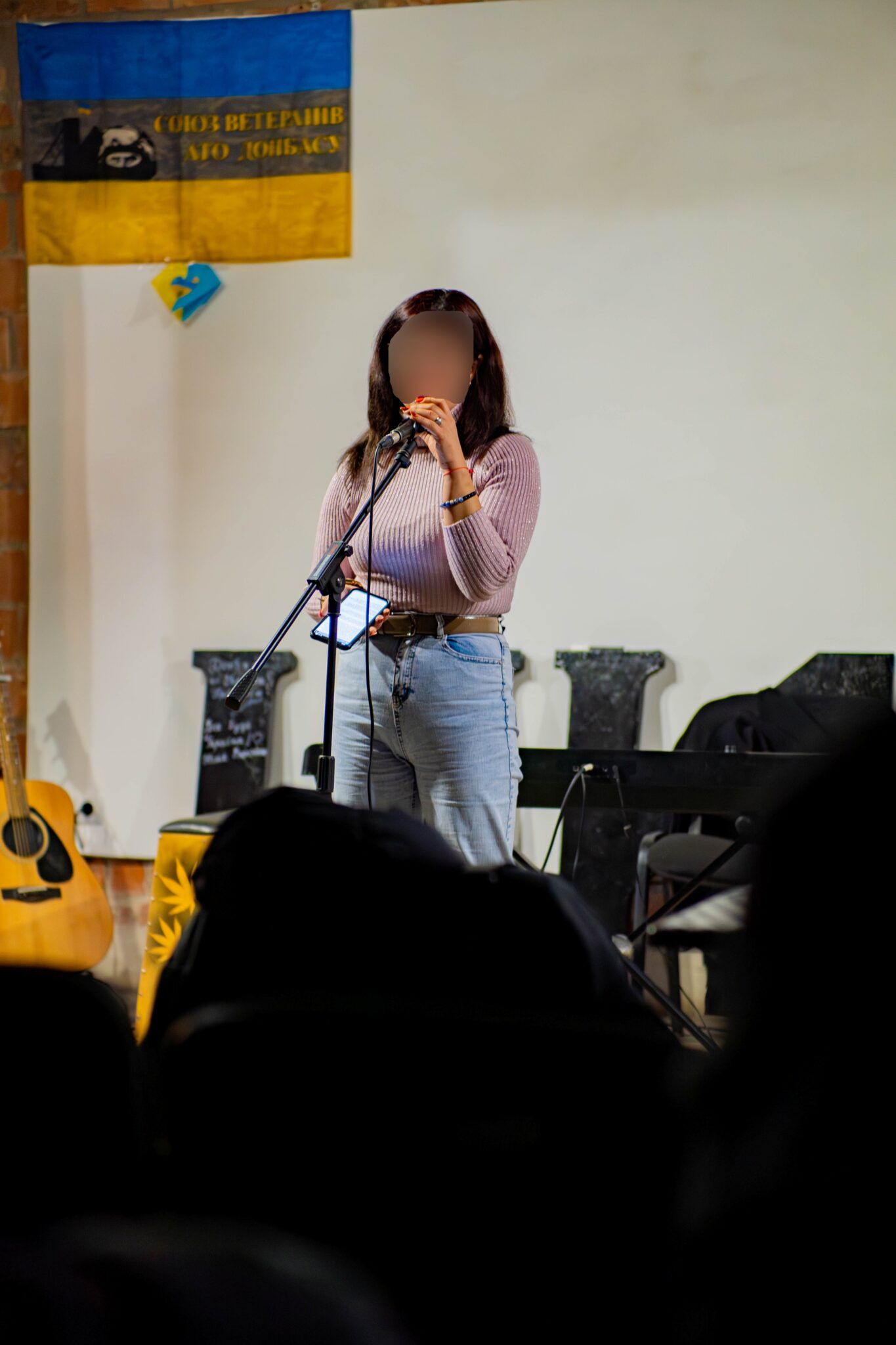
Medic from the public presenting her poem
Convinced of their commitment, the musicians want to extend it beyond the military sphere. “Last night, our concert was private. It was our own initiative, not by order of the brigade,” they explain. The experience was successful, and the musicians want to make it a weekly gathering. They hope to make art more accessible to soldiers and give them the opportunity to present their own compositions and poems.
“Soldiers are either on positions or forbidden to leave the Donetsk oblast. As a result, they cannot attend conventions.” The group wants to bring art to the soldiers, rather than it remaining in big cities. And for those who cannot leave their positions, allow them to present their poems by video.
“To conclude, I’d like to tell the West to stop thinking Russia can become a democracy,” one musician says, with the group’s approval. “Russia is a country of oppression, itself oppressed. There can be no art then, they understand only force and violence.”
“If they want to live in dictatorship, that’s their choice. We fought for our freedom, for our identity.” For these musicians, art is a necessary vehicle for keeping Ukraine’s identity alive. Music becomes an essential medium of resilience in a struggle for survival and the affirmation of their culture.
At man’s height, between the lines — Little Frenchy
Article's gallery
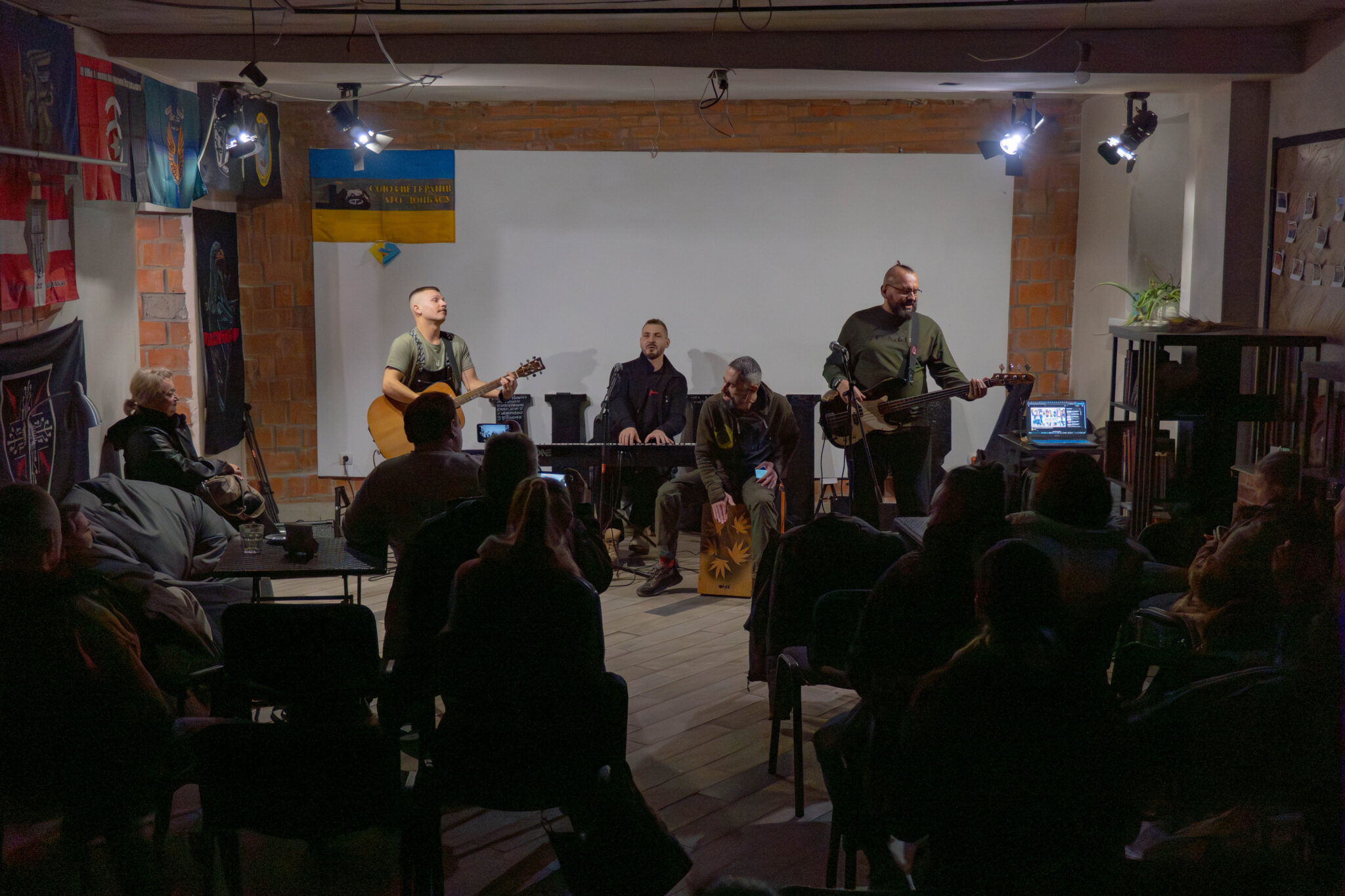
Military musicians giving a private concert for soldiers garrisoned in Kramatorsk
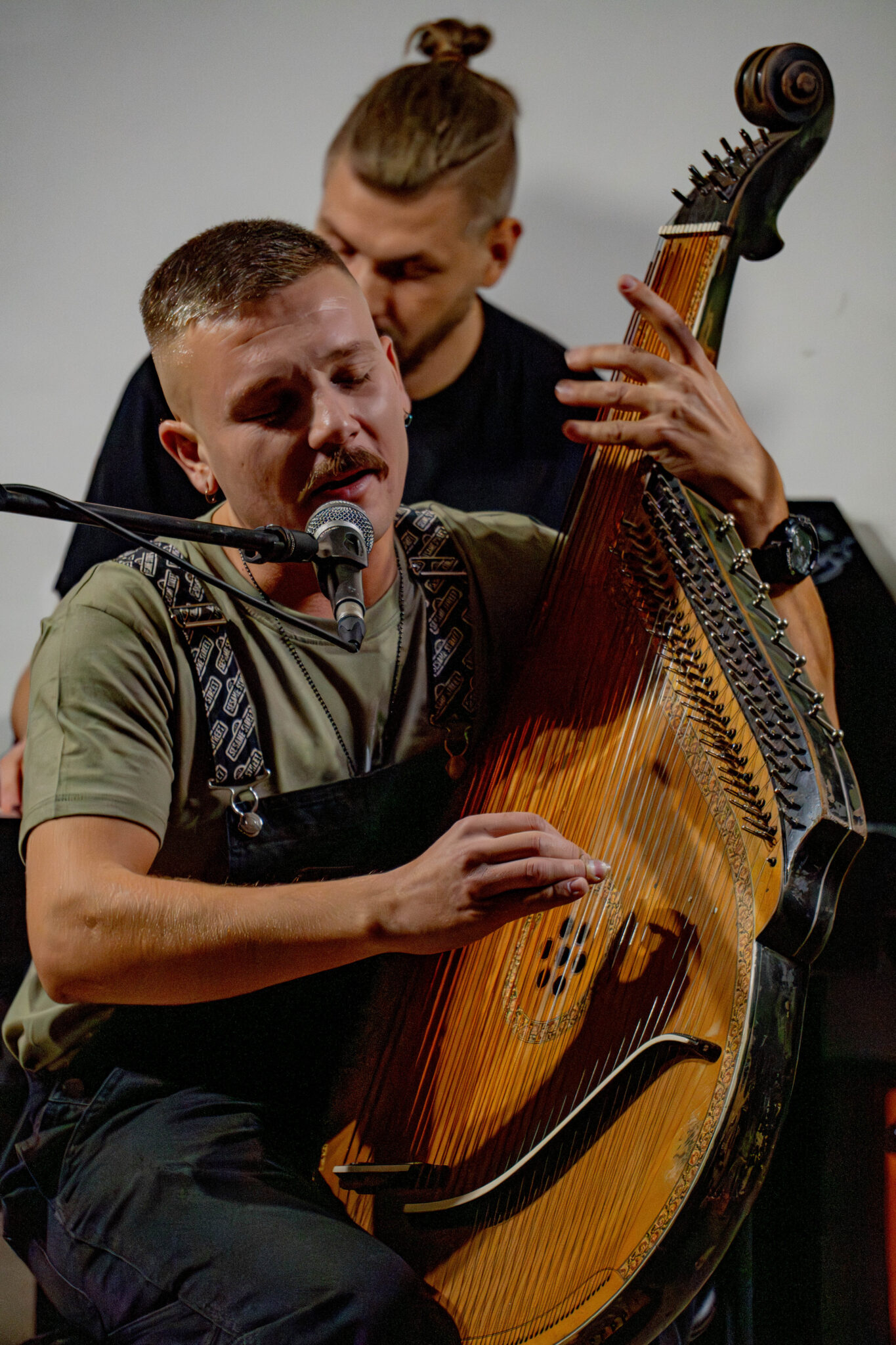
“The soldiers can join in and sing with us. It brings people together.” – soldier from the band
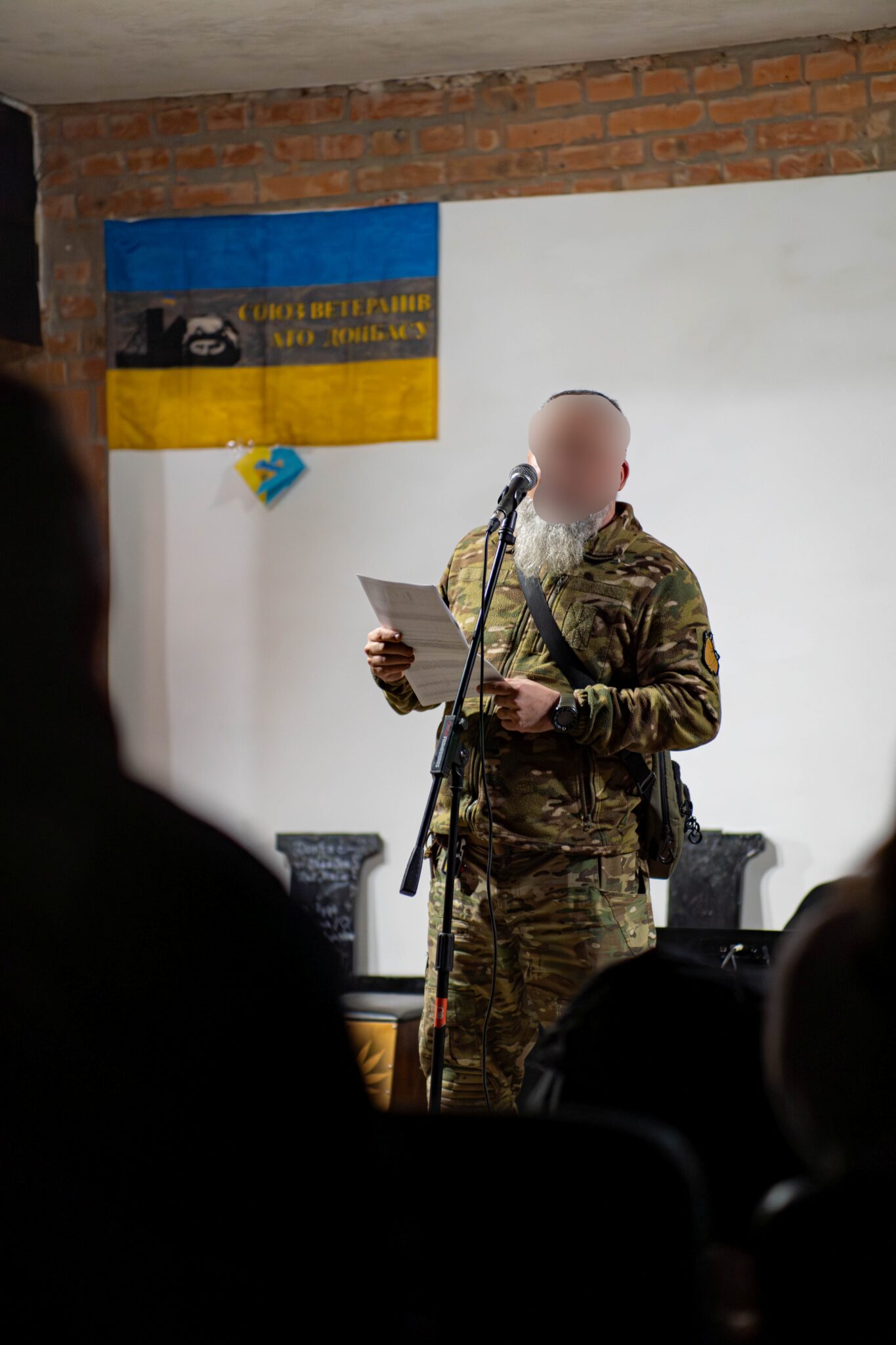
Soldier from the public presenting his composition
At man’s height, between the lines — Little Frenchy
06/01/2026